How Pilotbot Works: Pricing Engine, Positioning, and Safety Corridors
In simple terms, how the pricing engine keeps your P2P ads competitive — how price is selected, what safety corridors are, and why it works 24/7.
Pilotbot Team
Author
On this page
- Anatomy of the Problem: Why Manual Position Keeping Is Doomed
- How the Pricing Engine Calculates the Ideal Price
- 1. Order Book Scanning and Sanitization
- 2. Identifying the Target Competitor
- 3. Undercut Step Calculation
- 4. Instant Exchange Publication
- 3-Tier Safety Corridors: Capital Defense as an Axiom
- 1. Hard System Limit
- 2. Your Trading Band (Trader's Corridor)
- 3. Fallback Protection
- Why the Algorithms Run 24/7 Without Interruption
- Fail-Safe by Design: Handling Force Majeure Events
- Total Sovereignty: What Always Remains Under Your Control
- Read Next
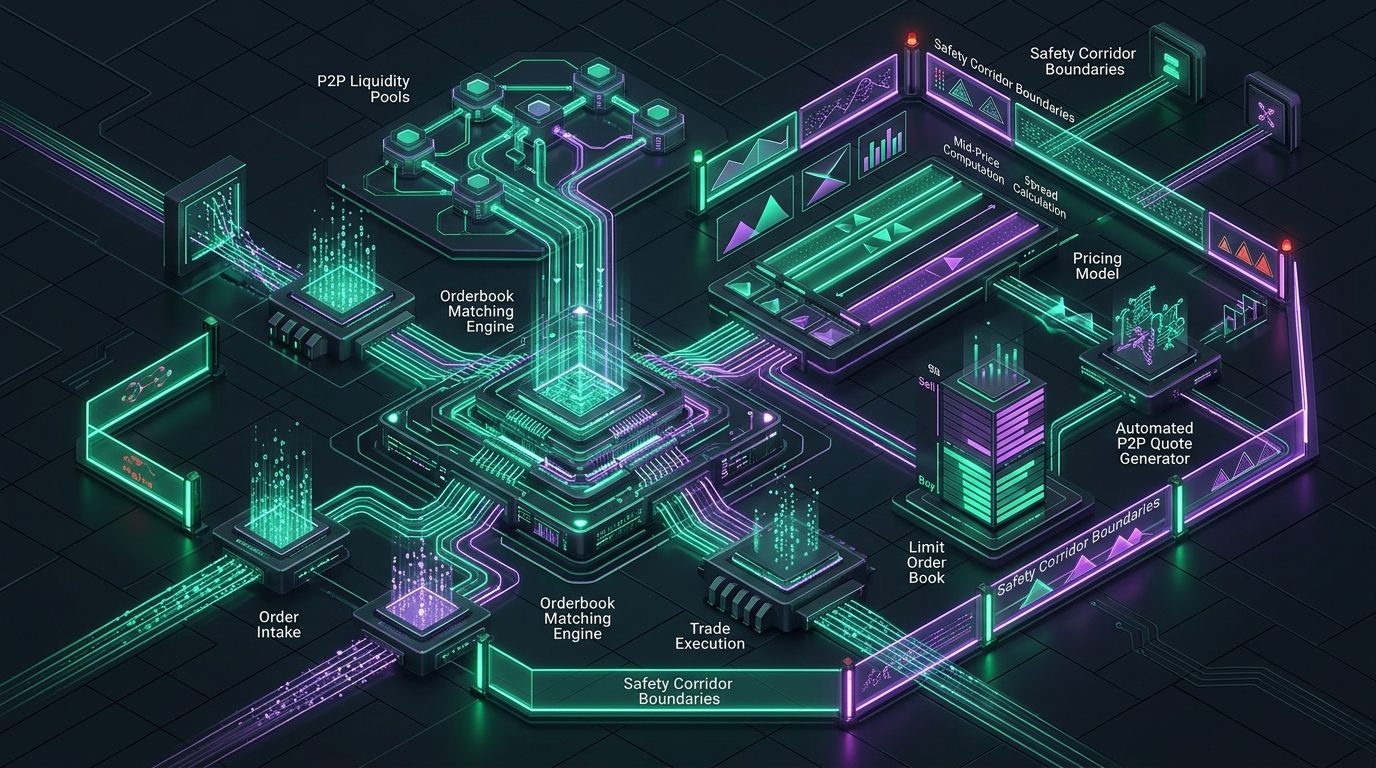
Order Book Dominance Architecture: How Pilotbot's Pricing Engine Commands the Market
In modern P2P trading, the struggle for order flow and spread unfolds in fractions of a second. The market order book is not a static storefront, but an ongoing, dynamic auction. The moment you step away for coffee or head to sleep, aggressive undercutting from competitors pushes your ads down to the second page of search results, slashing your trading volume to zero. Or, even more dangerously, a sudden market spike turns a profitable order into a severe loss.
Pilotbot solves this problem fundamentally.
Instead of chaotic manual adjustments and brittle browser scripts, the platform is driven by an autonomous Pricing Engine. This is the core of the P2P Trading OS: it scans market depth around the clock, computes the ideal entry point, keeps your ad in winning positions, and protects your capital with a 3-tier safety architecture.
Anatomy of the Problem: Why Manual Position Keeping Is Doomed
The P2P order book on Binance or Bybit is sorted by price: the most attractive rates for takers sit at the very top. The reality is that more than 80% of all trade volume is captured by the top three positions. Being at the top of the book guarantees immediate capital turnover; dropping out freezes your liquidity.
A trader working manually faces three insurmountable obstacles:
- Human Latency: Competitors adjust prices every 15–30 seconds. A human physically cannot monitor the order book 24/7 without breaks or fatigue.
- Margin Bleed: When fighting for the top spot, beginners often make a costly mistake: slashing their price by an entire dollar or euro instead of a minimal tick, destroying their own net margin.
- The Reverse Impulse Trap: Sudden spot price spikes catch static ads off guard: orders fill at stale, unprofitable rates before the trader can even react.
Pilotbot's Pricing Engine removes the human factor, transforming trading from grueling screen duty into a predictable, engineered process.
How the Pricing Engine Calculates the Ideal Price
Repricing in Pilotbot is not a race to the bottom. It is a precise mathematical calculation factoring in competitor filters, target rank positioning, and the market's minimum tick size.
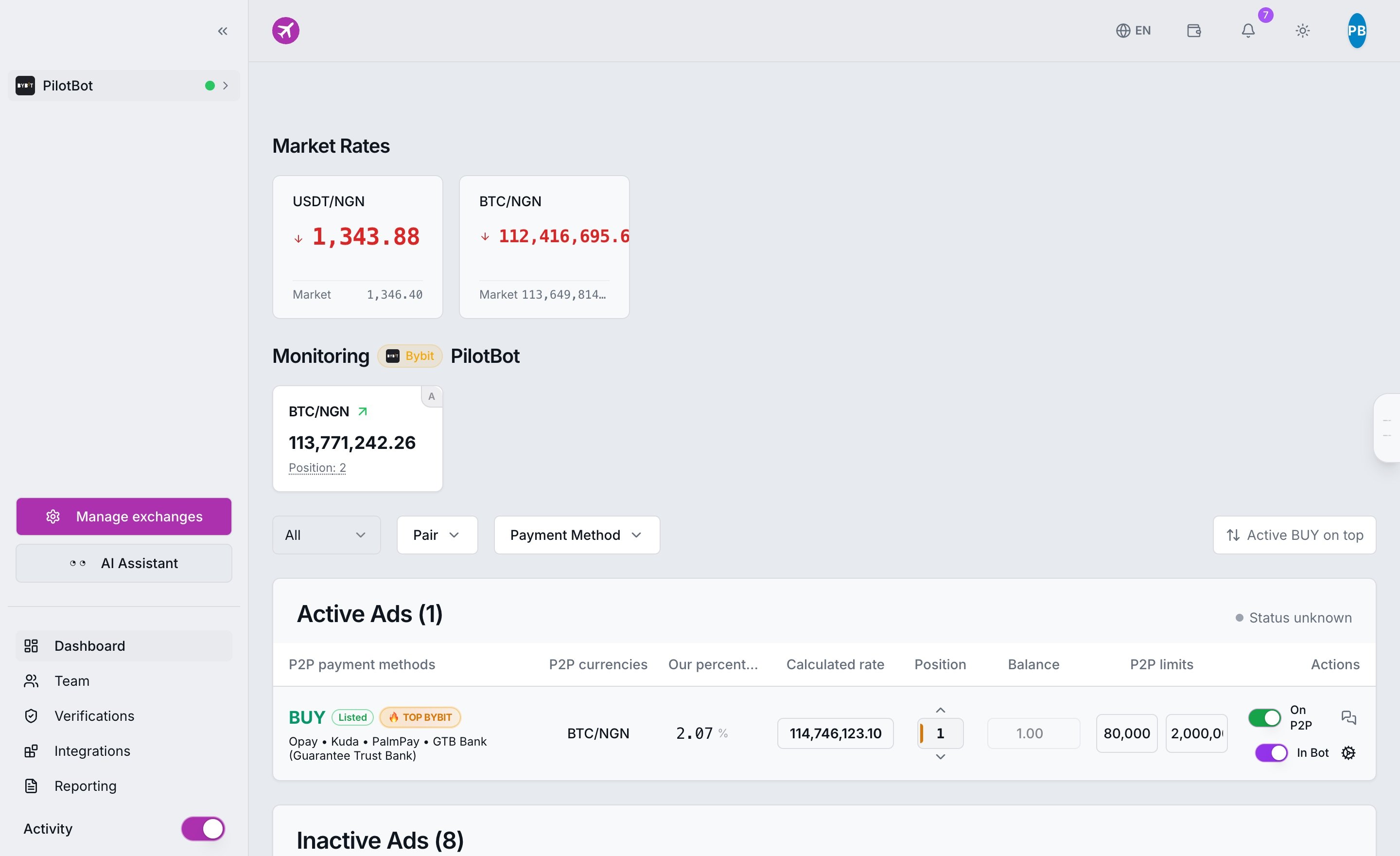
The algorithm executes a continuous 4-step loop:
1. Order Book Scanning and Sanitization
The system queries the order book for the target pair and payment method. Before calculating rank, the pricing engine filters out noise based on your criteria:
- Ignores blacklisted or suspicious competitors.
- Filters out illiquid ads with micro-limits (e.g., small orders that pose no real competition to a commercial desk).
- Retains only verified exchange merchants if the merchant-only filter is active.
2. Identifying the Target Competitor
Following filtration, the engine identifies the ad occupying your chosen Target Position (e.g., Position 1 or Position 2).
3. Undercut Step Calculation
Instead of giving away unnecessary profit, Pilotbot applies a precision step: exactly enough to place your ad ahead of the competitor by a single tick (e.g., +0.01 or +0.05).
4. Instant Exchange Publication
The calculated Target Price is validated against your safety corridors and dispatched to the exchange via the secure API gateway. Your ad claims its target rank in the top.
3-Tier Safety Corridors: Capital Defense as an Axiom
Every trader's primary fear when considering automation is: "What if the bot makes a mistake and sells off my balance at an unprofitable price?" In Pilotbot, safety is hardcoded into the architectural core: the system physically cannot submit a quote that jeopardizes your deposit.
Every calculated price must pass through three independent defense tiers:
+-------------------------------------------------------------+
| 1. HARD SYSTEM LIMIT (±19.9% from market benchmark)         |
|    Non-negotiable core platform barrier                     |
+-------------------------------------------------------------+
                              |
+-------------------------------------------------------------+
| 2. YOUR TRADING BAND (Minimum and maximum price)            |
|    Trader's custom bounds: protects minimum spread          |
+-------------------------------------------------------------+
                              |
+-------------------------------------------------------------+
| 3. SAFE FALLBACK PRICE (Fallback Quote)                     |
|    Safe haven quote when order book liquidity vanishes      |
+-------------------------------------------------------------+
1. Hard System Limit
The platform's fundamental safeguard: no ad quote may deviate from the reference market price by more than the system threshold (±19.9%). No exchange API anomaly or rogue single order can penetrate this protective barrier.
2. Your Trading Band (Trader's Corridor)
You set strict boundaries: a minimum sell price or a maximum buy price. If the market dips below your critical threshold, the pricing engine halts at your configured boundary. The ad will not chase price-cutting competitors into negative territory. If a price appears "frozen," it means the safety corridor is flawlessly defending your margin.
3. Fallback Protection
If the order book suddenly empties or market data feeds experience network degradation, the algorithm does not guess. It transitions your ad to a predefined safe fallback price or temporarily unpublishes it.
Why the Algorithms Run 24/7 Without Interruption
Pilotbot does not run locally on your laptop or smartphone. The pricing engine is deployed across an enterprise-grade distributed server cluster located in immediate proximity to cryptocurrency exchange data centers.
- Independence from Local Conditions: Your laptop can be closed, home Wi-Fi down, or phone battery dead. Trading workers continue repricing in real time.
- Ultra-Low Network Latency: Direct peering to Binance, Bybit, and other exchange data centers allows price recalculation and order updates within milliseconds.
- Exchange Rate Limit Compliance: Requests are throttled through an adaptive queue manager, preventing exchange API rate-limit bans.
Fail-Safe by Design: Handling Force Majeure Events
In financial engineering, the golden rule states: pausing trading is always safer than executing a trade at an erroneous price.
If an unexpected disruption occurs:
- the exchange stops responding to network requests,
- order book data becomes fragmented or contradictory,
- the exchange API key session expires,
Pilotbot immediately activates its Fail-Safe Protocol. The system places ads on safe pause rather than leaving them active with outdated prices. You receive an immediate alert, and your balance remains untouched.
Total Sovereignty: What Always Remains Under Your Control
Automation in Pilotbot is never a "black box." The architecture is built on absolute user sovereignty:
- Two Independent Toggles:
- In Bot — connects the ad to Pilotbot's pricing engine and algorithms.
- On P2P — controls physical visibility of the ad to buyers and sellers on the exchange. You can test calculations in the bot while keeping the ad hidden on the exchange, or vice versa.
- Absolute Price Bounds: The bot cannot mathematically bypass your configured minimums and maximums.
- Selective Activation: You decide exactly which pairs and ads to automate and which to manage manually.