Spread Strategy: Earn on the Spread Between Buy and Sell
How Pilotbot's spread strategy links buy and sell ads, holding the price difference within a corridor — within a single exchange or across multiple platforms.
Pilotbot Team
Author
On this page
- What Is the Spread Strategy
- Within a Single Exchange or Across Platforms
- 1. Single-Exchange Spread
- 2. Cross-Exchange Spread
- Anchor Architecture: How the Algorithm Protects Your Balance
- Setting Up a Pair in the AI Agent Interface
- Step-by-Step Launch Process
- Real-Time Monitoring and Smart Alerts
- Frequently Asked Questions
- What minimum spread is considered optimal?
- Can ads be on two different exchanges?
- Does the strategy bypass the global safety corridor?
- Related Articles

Spread Strategy: Protecting Net Profits in 24/7 P2P Arbitrage
In P2P trading, the winner is not the one who aggressively undercuts the order book, but the one who strictly controls the mathematics of the rate spread. Spread is the pure oxygen of arbitrage. You purchase cryptocurrency slightly below market price on one ad, sell it slightly higher on another, and the locked-in difference forms your net profit.
But the market never stands still. A sharp Bitcoin price spike, a surge in fiat demand, or an overnight price war among competitors is all it takes for the spread to suddenly collapse to zero or flip into the negative.
Pilotbot's spread strategy is designed to completely eliminate trading at a loss. It connects your buy ad and sell ad into a single, unbreakable pair and continuously maintains your margin strictly within your configured safety corridor 24/7.
What Is the Spread Strategy
At its core, the spread strategy is a dynamic financial bridge between two of your P2P ads:
- Buy Ad — the position through which you purchase cryptocurrency from counterparties for fiat.
- Sell Ad — the position through which you release cryptocurrency to counterparties at a markup.
Both ads operate on the exact same currency pair (e.g., USDT/RUB, USDT/KZT, or USDT/HKD). The AI agent calculates the effective difference between their prices in real time and maintains it within the boundaries of your spread corridor:
- Lower Bound (Minimum Spread) — the breakeven threshold below which trading loses economic rationale.
- Upper Bound (Maximum Spread) — an indicator of market anomalies, preventing ads from idling due to unrealistic prices.
When the market spread is wide and stable, you capture maximum profit from every trading turnover round. If competitors begin aggressively compressing the order book, Pilotbot's algorithm instantly adjusts quotations before market movements can touch your capital.
Within a Single Exchange or Across Platforms
The spread strategy is not restricted to a single exchange account. Depending on your business model, you can run two types of setups:
1. Single-Exchange Spread
Both ads (Buy and Sell) are hosted on the same platform — for example, on Binance. This is classic circular P2P arbitrage: retail users sell you USDT on your first ad, you immediately liquidate them through the second ad, and the protective corridor guarantees a fixed delta between entry and exit prices.
2. Cross-Exchange Spread
The buy ad is placed on one exchange, while the sell ad is on another (for example, buying on Bybit and selling on HTX or Binance).
This unlocks significant opportunities when liquidity and demand are unevenly distributed across platforms:
- You capture profit from structural cross-exchange arbitrage.
- The AI agent continuously compares prices across two independent gateways.
- If the selling rate drops on the target exchange, the bot synchronously lowers the purchase price on the initial exchange, preventing a cash-flow mismatch.
In the Pilotbot dashboard, both scenarios are managed identically: one unified pair card, one margin corridor, and unified risk management rules.
Anchor Architecture: How the Algorithm Protects Your Balance
To eliminate "price feedback loops" and avoid destabilizing the order book with erratic recalculations, Pilotbot utilizes a mathematically verified asymmetric anchor mechanism:
- The Sell Ad is the Anchor. The spread algorithm deliberately does not interfere with its price formation. The sell order follows its own independent rules — for example, holding a top-2 position via the Undercut strategy or tracking the exchange's baseline reference rate.
- The Buy Ad is the Controlled Leg. The bot executes all spread balancing exclusively by adjusting the purchase price:
- Spread drops below the minimum: The bot immediately lowers the crypto purchase price. Your buy rate becomes cheaper, and the gap between buy and sell expands back to safe levels. This acts as a strict barrier against buying expensive assets in a thin market.
- Spread remains inside the corridor: The bot does not intervene. Your ads rank normally, ensuring a continuous flow of trades.
- Spread exceeds the maximum: The bot carefully adjusts the purchase price upward. An excessively wide spread means your buy price is uncompetitive, causing the order to sit idle without fills.
Setting Up a Pair in the AI Agent Interface
Creating and launching a spread pair in Pilotbot takes less than a minute thanks to the intelligent conversational hub.
Step-by-Step Launch Process
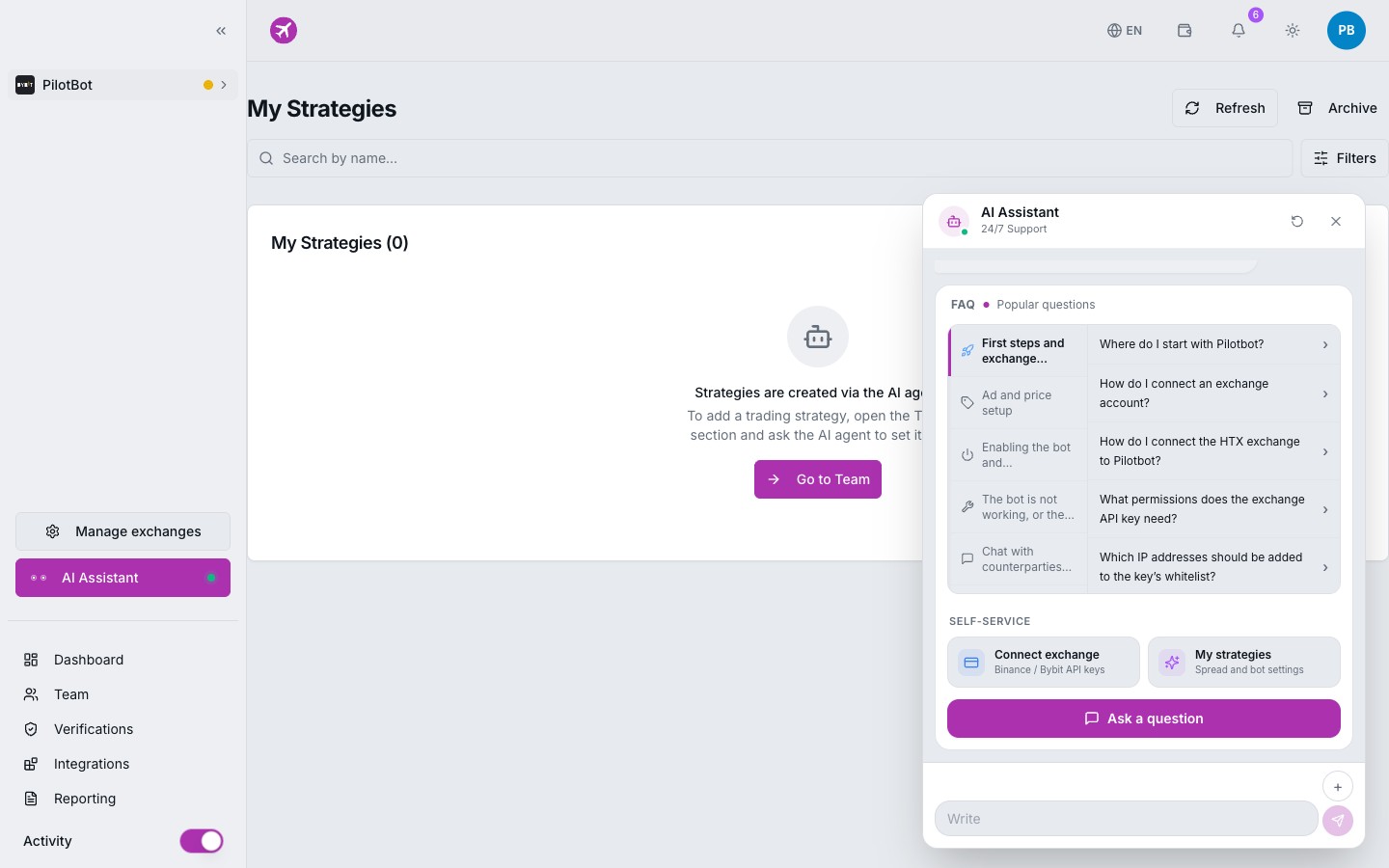
- Open the chat with the AI Agent. Navigate to the AI Agent section and describe your goal in natural language (for example: “Link USDT buy and sell with a 1% to 3% spread”) or choose the ready-made Spread Strategy preset.
- Select an ad pair. Pick two active ads for the same currency pair. The system automatically filters out ads already assigned to other active pairs to prevent algorithmic conflicts.
- Set corridor boundaries. Specify the minimum spread (your profit protection line) and the maximum limit. The default standard corridor is 1% to 60%.
- Configure the merchant filter. Enable “Merchants Only” to peg your calculations solely against verified exchange makers, completely filtering out price noise from unreliable one-off ads.
- Confirm and launch. Click Create Strategy — the algorithm will instantly link your ads and assume control over the order book.
Real-Time Monitoring and Smart Alerts
On the Pilotbot dashboard, each active pair is displayed as an interactive trading pair card:
- Current Spread Indicator: A visual color-coded bar showing the exact percentage gap between your buy and sell prices in real time relative to your defined corridor.
- Sync Status: Instant status overview of both orders on the exchanges (active, in order book, updating price).
- Instant Alert System: If market conditions shift rapidly and the spread begins to compress dangerously toward critical levels, the system triggers a high-priority spread collapse alert via Telegram and the notification bell in your personal dashboard, allowing you to instantly adjust limits or review order sizing.
Frequently Asked Questions
What minimum spread is considered optimal?
The minimum spread is your "red line" — the point where trading ceases to be profitable. Base this on your average net profit: if you operate with a 2–2.5% margin in a calm market, set your minimum threshold at 1–1.2%. This prevents false triggers from minor market fluctuations while reliably halting purchases if the market collapses.
Can ads be on two different exchanges?
Yes, absolutely. You can buy on Bybit and sell on Binance or HTX. Pilotbot's engine pulls order book data from both exchanges via official gateways and calculates the cross-exchange spread with tenth-of-a-percent precision.
Does the strategy bypass the global safety corridor?
No. All actions taken by the spread strategy are subject to the hard-coded ±19.9% safety corridor rule. The bot cannot physically place a buy or sell price outside the safe range around the reference market rate.