How Pricing Works — Safety Corridor and Position
How Pilotbot calculates your P2P ad price, what the safety corridor is, how order book positioning functions, and why it operates 24/7.
Pilotbot Team
Author
On this page
- The Foundation of Calculations: What Is Reference Price
- Safety Corridors: Two-Tier Armor for Your Capital
- 1. Hard System Corridor (±19.9%)
- 2. Trader's Soft Corridor (Personal Band)
- Battle for the Order Book: Target Position and Overtake Step
- Continuous 24/7 Cycle: Reliability Architecture
- Why Price Sometimes "Freezes": Protection, Not a Glitch
- Related Articles

Anatomy of Price: How Intelligent Pricing Works in Pilotbot
In the fast-paced world of P2P arbitrage and merchant trading, reaction speed and mathematical precision determine everything. The order book across crypto exchanges (Binance, Bybit, and others) shifts every second: rates fluctuate continuously, rival bots undercut quotes by fractions of a cent, and any impulsive competitor error can trigger a cascade of dumping.
Pilotbot turns ad price management into a reliable, high-precision, and fully automated process. The platform's pricing engine continuously scans market depth, calculates the ideal price for each order, and updates quotes on the exchange — 24/7, without interruptions, and strictly within unbreakable safety corridors.
The Foundation of Calculations: What Is Reference Price
Every price calculation in Pilotbot begins not with chaotic observation of random ads, but by determining the Reference Price — the objective, fair market value of your trading pair (for example, USDT/RUB, USDT/THB, or BTC/KZT).
The reference price serves as an unshakeable benchmark for the system:
- Market Benchmark: The algorithm continuously aggregates weighted quotes from spot and OTC markets to establish a live market baseline.
- Manipulation Filtering: In P2P order books, competitors frequently post phantom bait ads with tiny volumes (such as a 500-ruble order at an artificially depressed rate) to trick external bots into destructive dumping. Pilotbot compares every offer against the reference price and filters out manipulation.
- Anchor for Protection: All system safety corridors are anchored directly to the reference price, eliminating the risk of shifting the baseline due to localized order book anomalies.
Safety Corridors: Two-Tier Armor for Your Capital
The greatest danger in automated trading is sudden order book slippage, an exchange software glitch, or a human typing error (fat-finger). If an unconstrained script attempts to overtake the leader at any cost, it can liquidate your entire balance at a deep loss.
Pilotbot's architecture implements robust two-tier protection:
1. Hard System Corridor (±19.9%)
An absolute system invariant of the platform core:
- The price of any ad of yours is always and under all circumstances kept within ±19.9% of the current reference price.
- If the target price leaves these boundaries for any reason, the engine automatically applies clamping — the price is smoothly clipped to the extreme allowable threshold.
- No user settings, operator commands, or AI agent algorithms can disable or breach the hard corridor. (For environments with dedicated browser extensions like HTX where direct exchange reference feeds are unavailable, an extended range of ±100% applies).
2. Trader's Soft Corridor (Personal Band)
Within the system barrier, you define your own commercial boundaries:
- Minimum Sell Price (Floor) and Maximum Buy Price (Ceiling).
- Minimum Allowable Spread: The profitability threshold below which trading loses economic sense.
- The pricing engine actively optimizes quotes strictly within your personal profitability band.
Battle for the Order Book: Target Position and Overtake Step
Once the safety perimeter is reliably secured, the tactical order book positioning layer is activated.
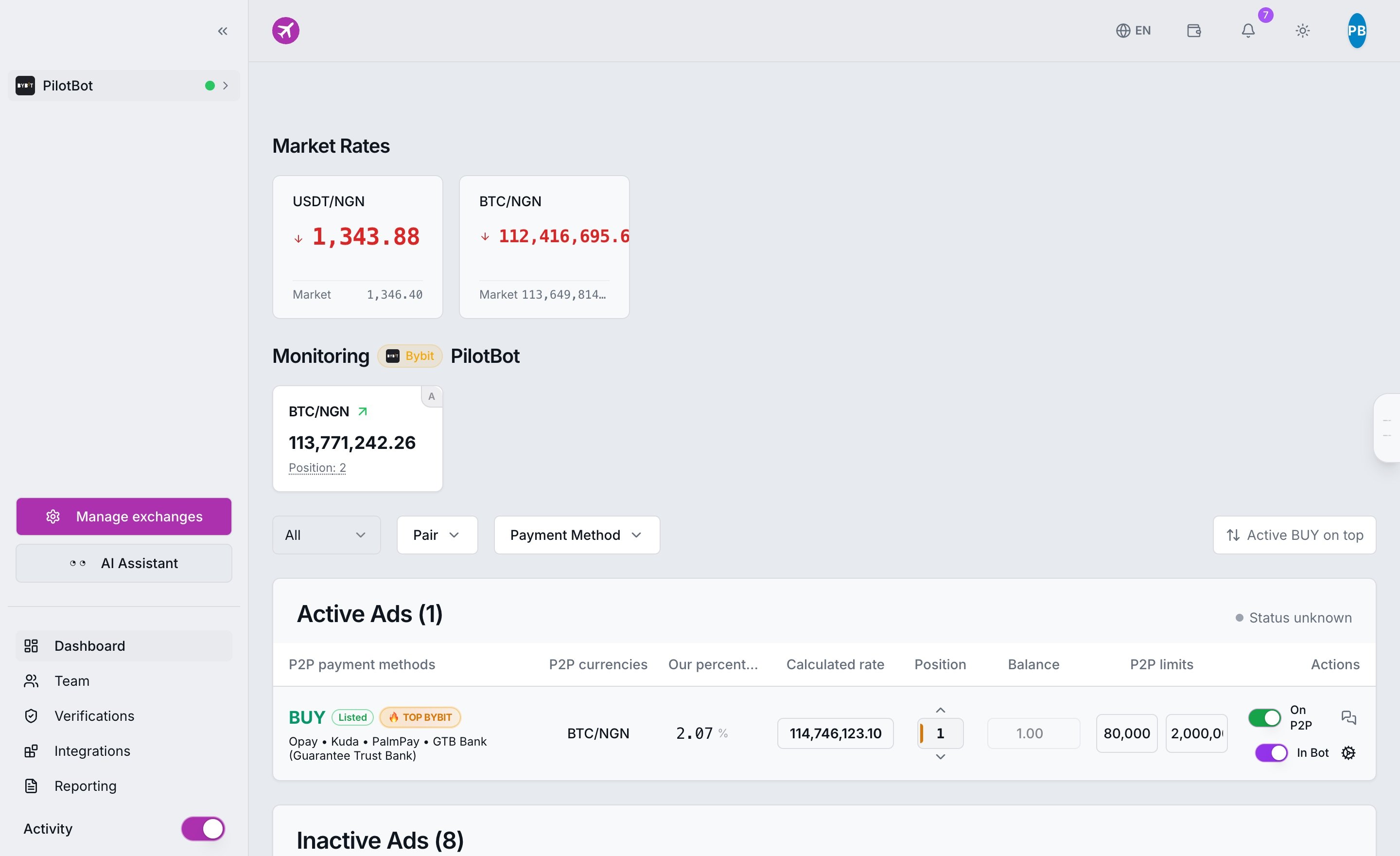
Pilotbot calculates not an abstract price, but a concrete rank in the order book:
- Target Position: You determine your desired rank in the listings. A value of
1indicates fighting for absolute leadership (first row of the book),2holds second place right behind the leader,3holds third, and so on. - Overtake Step: The minimum price increment by which you outbid the competitor. For example, if the step is
0.01and the nearest rival sells at92.50, Pilotbot posts92.49, securing your position win with minimal spread sacrifice. - Smart Competitor Segmentation: The engine competes only with relevant rivals — those with matching payment methods (Sberbank, T-Bank, SBP, etc.), trade limits, and verification parameters.
Continuous 24/7 Cycle: Reliability Architecture
Pilotbot operates as a full-fledged operating system on fault-tolerant servers. You do not need to keep exchange terminals open or leave your laptop running overnight:
- Continuous Polling Cycle: The background worker scans market order books every few seconds.
- Parallel Computation: The system cross-references the benchmark, filters invalid merchants from the order book, and finds the target price.
- Idempotent Writes: Price changes are dispatched to the exchange with ad-level mutex locking, preventing duplicate requests and race conditions across parallel threads.
- Plan-Based Priority: Advanced plans receive higher-frequency recalculation ticks, providing split-second execution during spikes of volatility.
Why Price Sometimes "Freezes": Protection, Not a Glitch
Occasionally traders notice that an ad price has not moved for some time and wonder whether the automation is functioning.
In the vast majority of cases, a steady price is evidence that protective algorithms are operating as intended:
- You Are Already at the Target Position: If competitors have made no moves and your ad already occupies the specified row with the desired spread, Pilotbot avoids wasting exchange API limits.
- Safety Corridor Triggered: The market has temporarily entered an unprofitable zone. The bot has pinned the price to the safe corridor boundary, preventing you from executing loss-making trades.
- Pseudo-Competitor Filtered: The price shift in the order book came from a merchant who fails your filters (for example, incompatible payment method or mismatched order limits).